Written by Sandie Barrie Blackley, Speech-Language Pathologist
Published on June 24th, 2026
Some critics argue that phonics activities undermine the joy of reading. Others insist that systematic phonics is essential. Parents reading the headlines could be forgiven for asking, "Is phonics good or bad?" The truth is more nuanced. Successful reading instruction requires the combination of phonics and purposeful, meaningful reading.
Phonics is to mastering literacy what scales and chord progressions are to mastering a musical instrument. Students don't fail to master an instrument because they were taught scales and chord progressions. But they may fail to master it if they don't learn how the foundational scales and chord progressions relate to musicality.
Of course, in modern life, the risks of low literacy are much higher than the risk of low musicality! If a school fails to implement phonics in a way that connects those foundations to the melody of proficient reading and writing, children often fall further and further behind. This can happen when schools lack clarity about the role of foundational skills such as phonemic awareness and phonics, or when they fail to differentiate instruction and practice to meet the needs of individual developing readers.
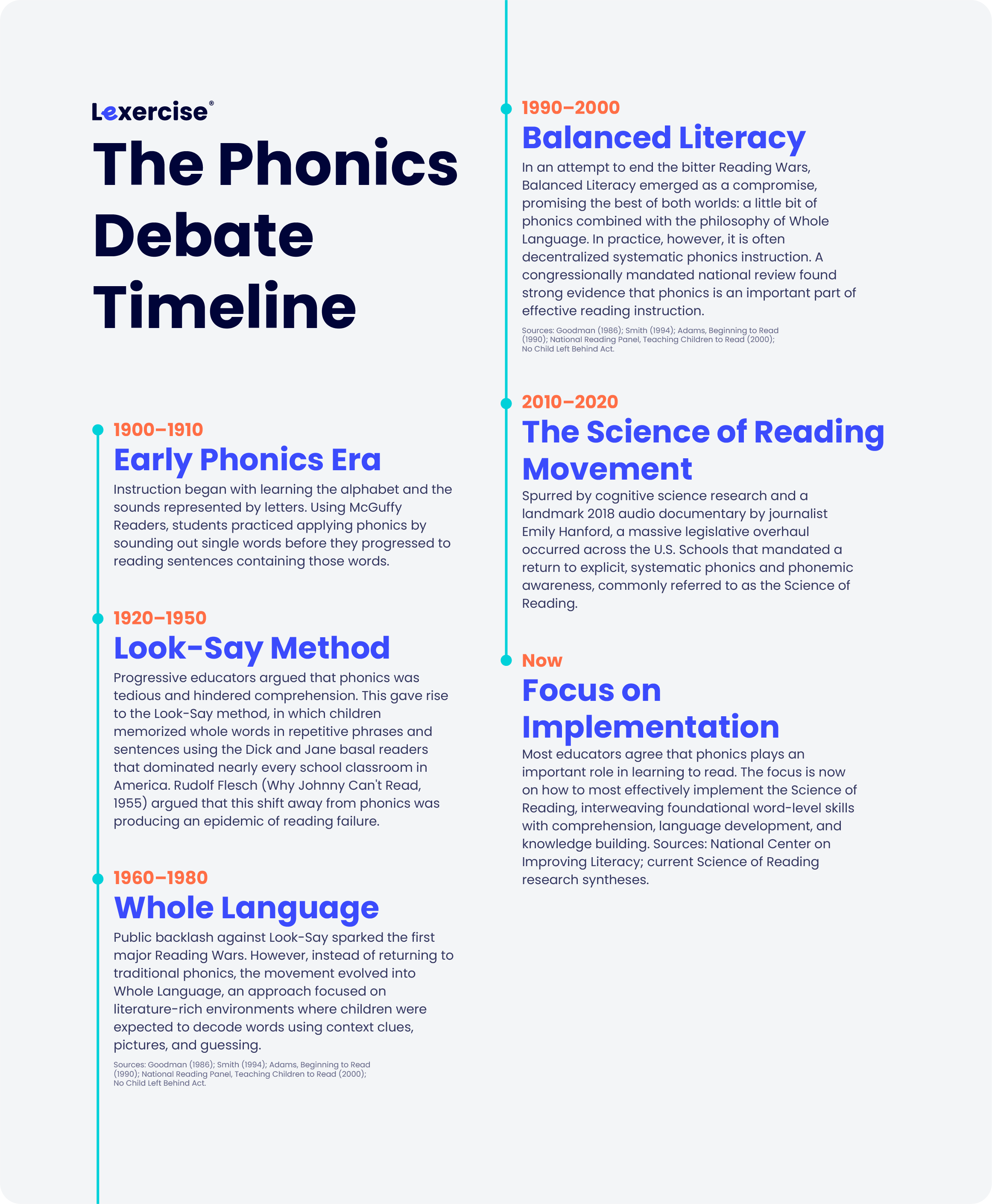
For decades, U.S. classrooms have swung through a phonics vs. whole-language debate. Whole language emphasizes mastery through immersion and meaning-making, assuming that exposure is the main driver of literacy. Phonics, by contrast — especially when grounded in the Science of Reading — emphasizes that systematic, explicit decoding instruction is necessary for most students to master literacy.
This debate has resurfaced loudly in recent years for a few reasons:
There is a real tension here. Some parents worry about "drill and kill." Others worry that phonics is being abandoned too quickly, especially for students who have not mastered reading by Grade 3. But this is not a debate about whether phonics matters. The research is clear: systematic phonics instruction grounded in the Science of Reading improves decoding outcomes. The real question is how phonics-based instruction is delivered — especially for struggling readers and children with dyslexia.
Students with dyslexia absolutely require explicit phonics instruction. But they need more than that. Effective intervention also requires:
General classroom phonics instruction — even when it is aligned with the Science of Reading — often is not enough to meet dyslexia-level needs.
Dr. Mark Seidenberg, a cognitive scientist and author of Language at the Speed of Sight, has been a major proponent of the Science of Reading, but he has also offered important critiques of how decoding instruction is currently implemented in many classrooms. Seidenberg advocates for a cognitive-science-aligned approach to decoding instruction for all students:
Rachel Canter, the founder and longtime executive director of the successful ed-reform group, Mississippi First, says that accountability is key. She advises: "Build a system, not a campaign."
These two terms sound similar, but they are not the same — and confusing them can cause real harm.
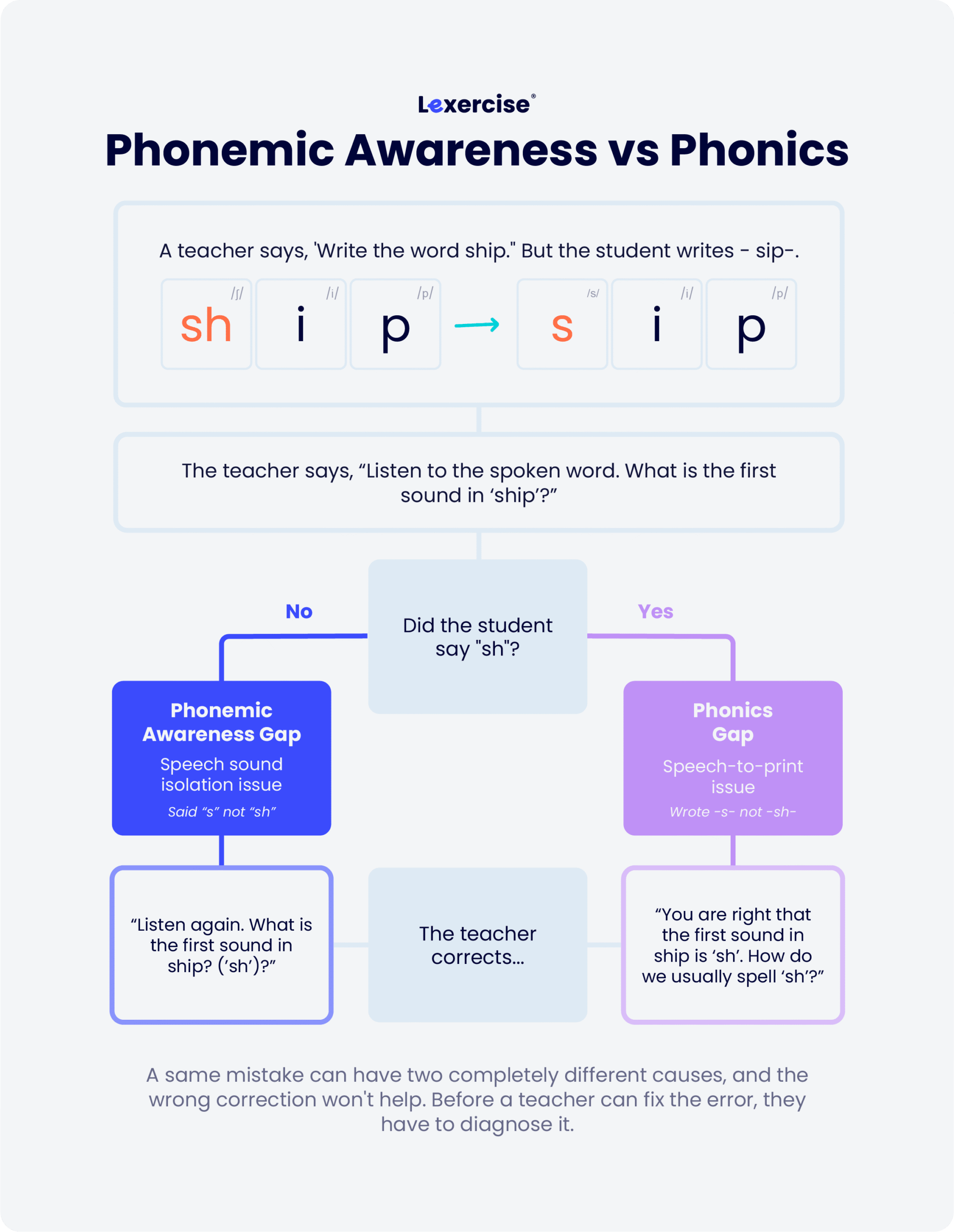
Recent research has demonstrated that phonemic awareness skills are best developed in tasks that integrate phonemic awareness and phonics. This is important because using such tasks can dramatically increase instructional efficiency, meaning students can master decoding more quickly. But integrated tasks can also make it hard for teachers to respond appropriately to a struggling student's errors. Imagine the teacher writes the word "ship" on the board and asks students to change it to the word "chip" and write it on their papers. This is a task that integrates phonemic awareness and phonics because it requires the student to:
A lot of teaching and learning power lies in how the teacher responds to the student's error, but that means the teacher must know what kind of error it is and what to say to help the student correct it. For example, if the student is asked to write ship and instead writes sip, the teacher needs to determine if the problem is related to speech sounds processing (perceiving the "sh" sound as "s") or if they perceive the sound correctly but don't know how to spell it in this word.
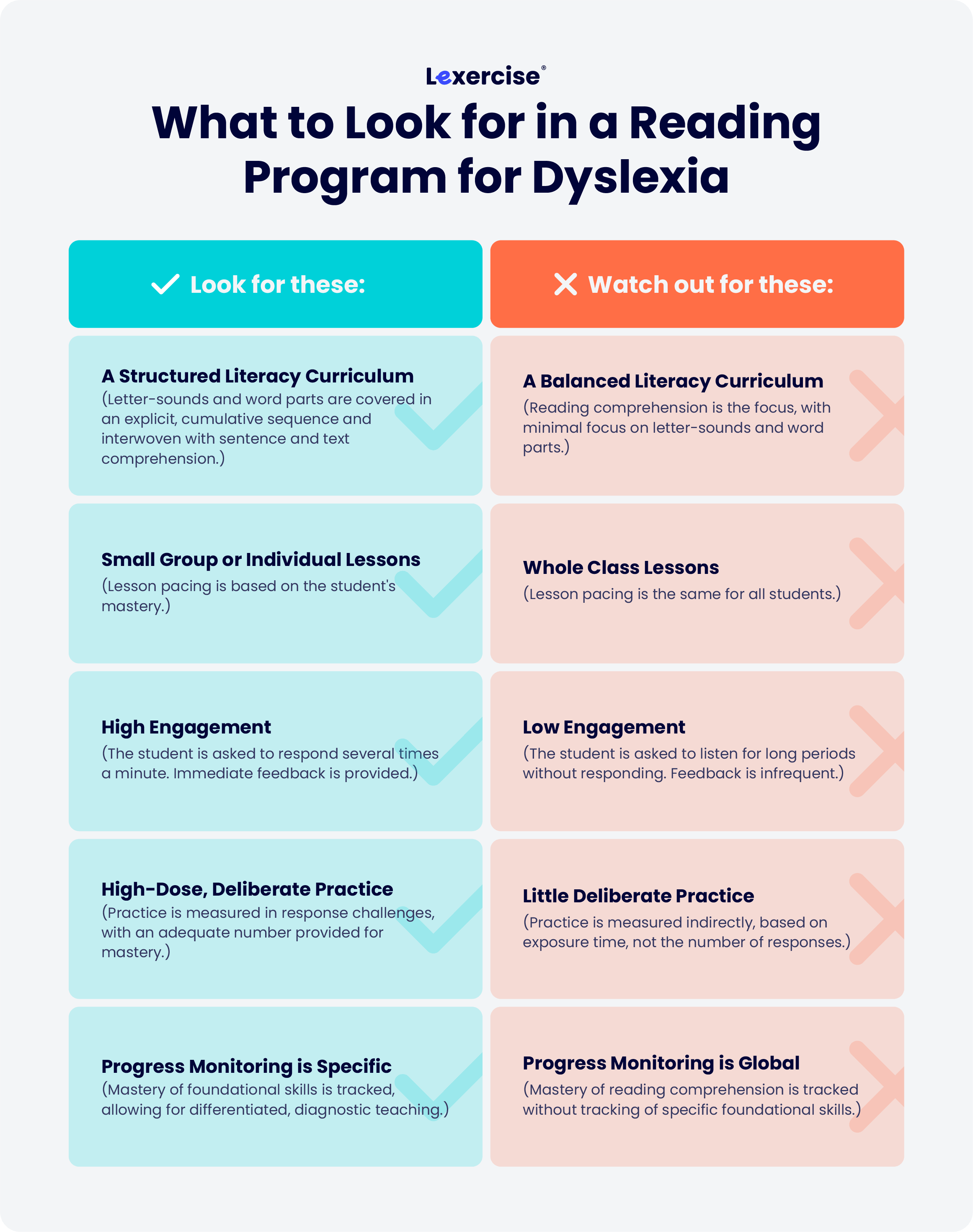
Not all phonics-based reading programs for dyslexia are created equal. The most effective programs share several features:
By contrast, programs that struggle to meet dyslexia-level needs tend to share a different set of features:
Hooked on Phonics* is one of the most familiar names in phonics, and parents often ask whether it is effective. The honest answer is that Hooked on Phonics can provide early exposure to decoding that may benefit some children, but it was not designed for struggling readers. Children with dyslexia generally require the guidance of a specialist and intensive, structured literacy intervention that goes well beyond app-based programs. Hooked on Phonics may be appropriate for some learners; it is not a substitute for intervention.
Reading experts have summarized it this way: "Hooked on Phonics is good for students who don't need it."
This is where Lexercise comes in. We bridge research and results with:
If your child is a struggling reader, request a free consultation with one of our teletherapy partners today.


* Hooked on Phonics is a registered trademark of Sandviks HOP, Inc. Mind InFormation, Inc. is not affiliated with, sponsored by, or endorsed by Sandviks HOP, Inc.
Schedule a FREE
15-minute consultation