
What Does Reading on Grade Level Mean?
Written by Sandie Barrie Blackley, Speech-Language Pathologist
Published on November 10, 2025
Every week, Lexercise therapists talk with parents who are concerned that their child is reading “below grade level.” In most cases, the child’s teacher has told the parents that the child struggles to keep up. Even when parents observe their child’s reading difficulties, they may not understand the meaning of grade-level reading or what can be done to help the child improve.
What Is Reading at Grade Level?
Grade-level reading is defined as the average passage difficulty level (as measured by one of the many readability formulas) that most students at a specific grade level can read with understanding. Again: grade-level reading is what most students at a grade level can read. If this definition seems circular, it is!
Why Reading Levels by Grade is a Complex, but Important Metric
Reading is a complex activity; it is not a single thing. Consider the differences in reading:
- a food ingredients label
- a pharmacy insert
- a bus schedule
- a ballot initiative
- an owner’s manual for a car or appliance
- an Internal Revenue Service (IRS) publication
- a workplace policy manual
- a news article
- an opinion article
- a poem
- a book
Further, within each of these examples, the difficulty level can vary widely. Just as some books are more complex than others, some food labels are more complex than others.
Attempts to capture reading difficulty levels have typically focused on passages or books. Over the years, different readability formulas have been developed to index the difficulty level of passages. These formulas count elements like word length (number of syllables, number of letters), word frequency, and sentence length. But, even with all the diligent counting, there is no agreed-upon standard for indexing the difficulty of reading a written passage.
The Issue with Evaluating Reading Levels by Grade
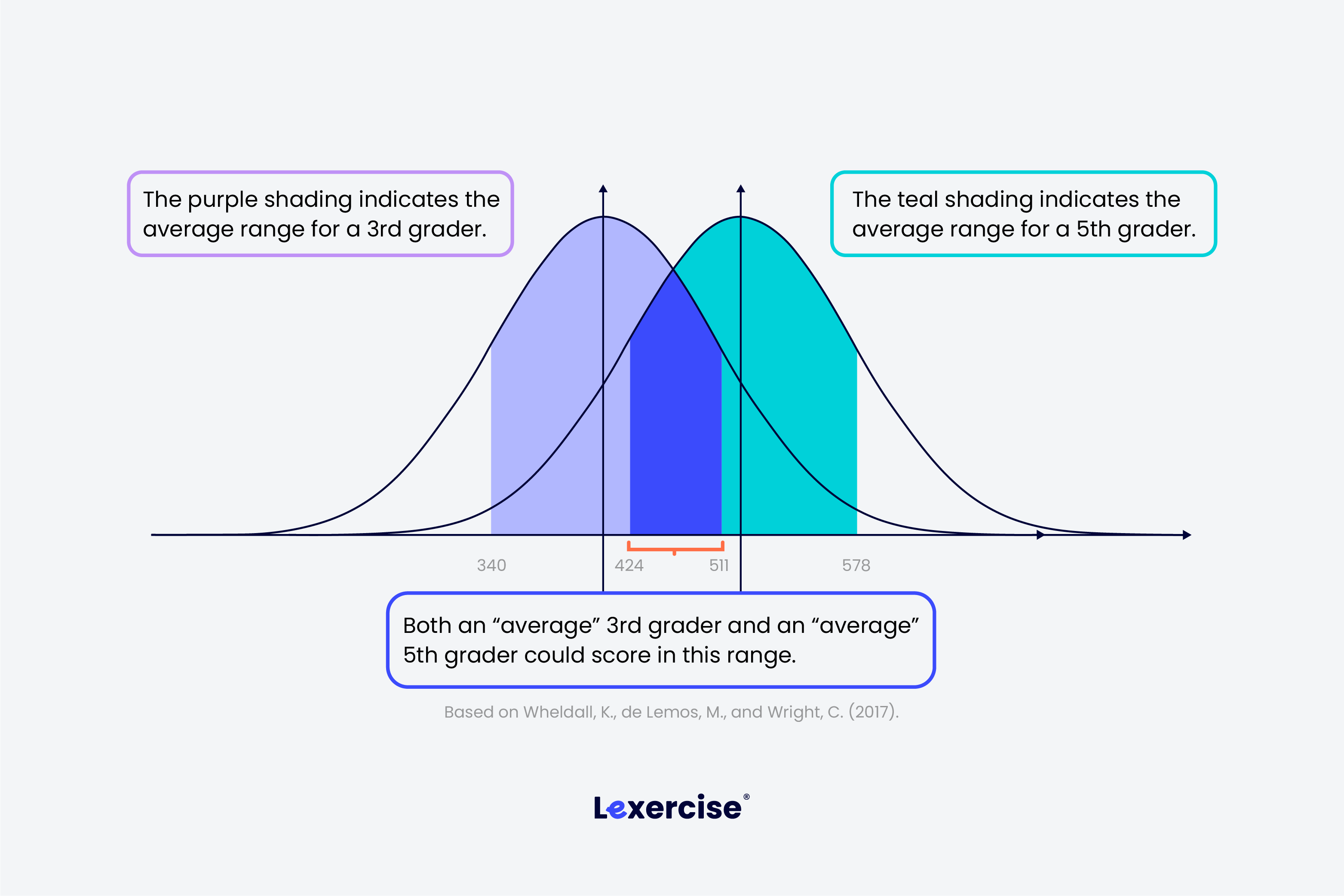
A big problem with using “grade-level” as a meaningful measure of reading is that there is huge overlap across grades in the difficulty level of passages that students can read and understand.
As shown in the graph below, the reading averages for certain grades can overlap significantly. An “average” 3rd grader and an “average” 5th grader could have the same score! This highlights how broad and imprecise these grade-level distinctions can be—and when issues arise, it’s important to have qualified educators understand a student’s situation and performance more holistically.
Understanding Grade-Level Reading
We are used to thinking about grade-level reading as a single number, such as “My child is reading at a 3rd-grade level.” But it would be more accurate to think of reading level as a range. For example:
- Early elementary (grades K-3) reading level
- Late elementary (grades 4-5) reading level
- Middle school (grades 6-8) reading level
- Early secondary (grades 9-10) reading level
- Late secondary (grades 11-12) reading level
Children may read below their grade level for several reasons. Dyslexia is a common issue that makes it difficult for kids to decode words and understand text. Other factors may include inadequate early reading instruction, insufficient practice, or language barriers. Additionally, conditions like attention deficit hyperactivity disorder (ADHD) or visual impairments can also impact reading skills. Identifying the root cause is crucial for providing the right support and helping children improve their reading abilities.
How to Determine Reading Level
To determine a student’s reading level, educators typically assess three key skills:
- Accuracy: How correctly the student reads words in a passage.
- Fluency: How smoothly and at an appropriate pace the student reads aloud.
- Comprehension: How well the student understands and interprets what they read.
Teachers often use tools such as running records, leveled reading systems, and standardized reading assessments to measure these skills and match students with texts that suit their level.
How to Improve Reading Level for Students
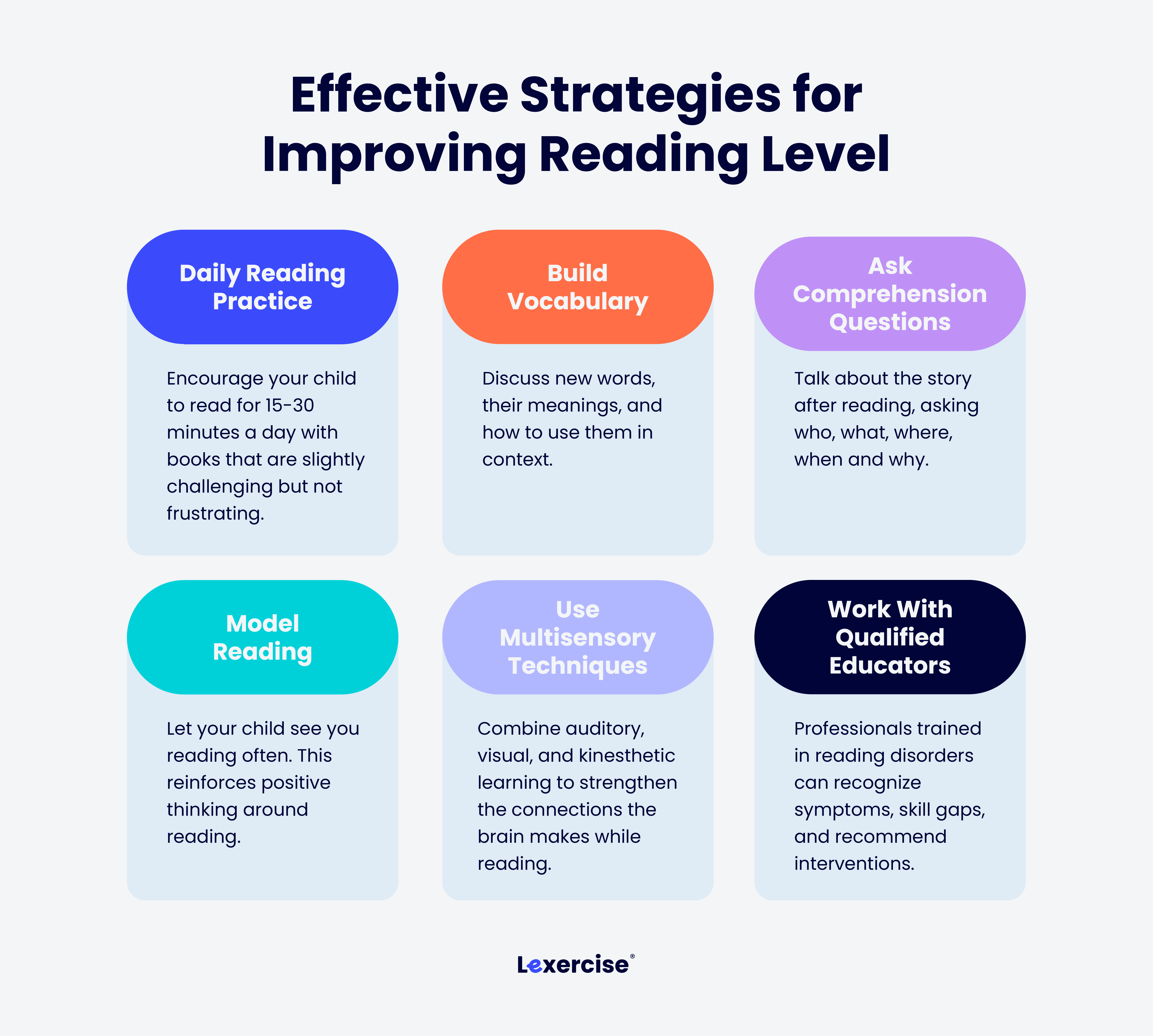
Improving a child’s reading level involves consistent practice, targeted instruction, and encouragement. Some effective strategies include:
- Daily Reading Practice: Encourage your child to read for 15–30 minutes each day using books that are slightly challenging but not frustrating.
- Build Vocabulary: Discuss new words, their meanings, and how to use them in context.
- Ask Comprehension Questions: After reading, talk about the story—ask who, what, where, when, and why questions to deepen understanding.
- Model Reading: Let your child see you reading regularly. This reinforces that reading is valuable and enjoyable.
- Use Multisensory Techniques: Combine visual, auditory, and kinesthetic learning (such as explicit guidance for letter formation) to strengthen reading connections.
- Work With Qualified Educators: Teachers and reading specialists can identify specific skill gaps and recommend personalized interventions.
When Reading Struggles Persist
If your child continues to struggle despite consistent support, dyslexia or another learning difference may be affecting their reading performance. Dyslexia impacts how the brain processes written language, making decoding and fluency more difficult. In this case, seek a formal evaluation and ask about specialized reading interventions designed for dyslexic learners. Early identification and tailored instruction can make a significant difference.
Lexercise: Helping Students Improve Reading Level
If your child is a struggling reader or you have been told your child is reading below grade level, Lexercise can help. Lexercise identifies and treats dyslexia and other learning difficulties with online reading, writing, and spelling therapy. Children who complete the Lexercise program improve 3 grade levels on average!
If you are interested in finding out your child’s current reading, spelling, and writing grade level, or if you have noticed that they might need extra help getting to the next level, we recommend exploring our Reading & Spelling Inventory assessment. Schedule a call with one of our expert therapists today to learn more.
Improve Your Child’s Reading
Learn more about Lexercise today.
Schedule a FREE
15-minute consultation