
What Schools Get Wrong About the “Science of Reading”
Written by Sandie Barrie Blackley, Speech-Language Pathologist
Published on March 10, 2026
The “Science of Reading” has become one of the most talked-about movements in education. States are passing laws, districts are retraining teachers, and parents are demanding change. On the surface, that’s good news. But translating research into classroom practice is not simple. When schools misunderstand—or oversimplify—the Science of Reading, students can still struggle. The problem isn’t the science. It’s how the science is implemented.

Why Are We Hearing So Much About the Science of Reading?
While the cognitive science behind how humans learn to read has existed for decades, several catalysts recently pushed the Science of Reading from the lab into mainstream policy and practice:

Journalism
Investigative journalist Emily Hanford’s 2022 podcast, “Sold a Story,” reached millions of parents and educators, shifting the narrative about how best to teach students to read from a dry academic debate to a high-stakes investigation into why so many students are struggling readers.

The “Mississippi Miracle”
An apparent proof-of-concept was provided by the State of Mississippi, which saw a dramatic rise in Mississippi students’ reading scores after its mandated teacher training in the Science of Reading and systematic phonics. Something similar appears to be underway in Louisiana, and perhaps in Tennessee and Alabama as well. (Lexercise is a part of this miracle since we created the Mississippi Dyslexia Screener.)
Advocacy
Grassroots groups, such as Decoding Dyslexia and the NAACP, lobbied for this type of systematic instruction grounded in the Science of Reading.
Falling Reading Scores
Urgency was created in response to the post-pandemic declines in reading scores, the largest in decades, showing that 65% of U.S. fourth graders are not reading at a proficient level.
Has The Science of Reading Been Debunked?
The Science of Reading is not a single curriculum, a new fad, or a popular idea; it is the entire body of research, thousands of studies, across many decades and disciplines, including cognitive psychology, linguistics, neuroscience, and education, that, taken together, explain how the human brain learns to read and how students can best be taught.
As is common in science, there is debate and controversy about the Science of Reading. However, like all sciences, it is constantly evolving and being revised. Some elements will eventually be debunked or qualified, while others will be affirmed. Consensus is used to delineate the current tenets of the science. Consensus is typically reached when the same result is reported across many peer-reviewed studies, in multiple disciplines, using different methods.
According to the current Science of Reading, difficulties with decoding (word recognition) are overwhelmingly the primary cause of reading failure, especially in the early grades, with 70% to 80% of all struggling readers having a primary deficit in word recognition and decoding. The scientific consensus on how students learn to read words automatically and effortlessly is that it involves a phenomenon called orthographic mapping. The consensus stipulates that orthographic mapping requires the brain to link three distinct things:
- Phonemes: The word’s speech sounds
- Graphemes: The letters used to spell the speech sounds.
- Meaning: The mental concept of the word.

Of course, as the Science of Reading makes clear, word recognition is only part of what is required for reading proficiency. Reading proficiency is much more complex than just decoding individual words. But since decoding is by far the most common cause of reading struggles, let’s look specifically at how the decoding (orthographic mapping) consensus is implemented in classrooms.
The Research-to-Practice Gap
The gap between the Science of Reading and actual classroom practice is a phenomenon often referred to as the Research-to-Practice Gap. While science provides a clear blueprint for how the brain learns to read, the logistics of a school system are infinitely more complex than those in controlled research settings.
Implementing science-backed methods in real-world settings is challenging. This challenge has spawned a science of its own: Implementation Science, the study of how to close the gap between what we know works (evidence) and what we actually do (practice).
It is often described as the science of how.
For example,
- Reading science has demonstrated that orthographic mapping (linking speech sounds, letter spelling, and meaning) is necessary for learning to read.
- Implementation science focuses on how teachers and schools can most effectively teach orthographic mapping, also known as decoding.
The Four Necessary Elements of Teaching Decoding
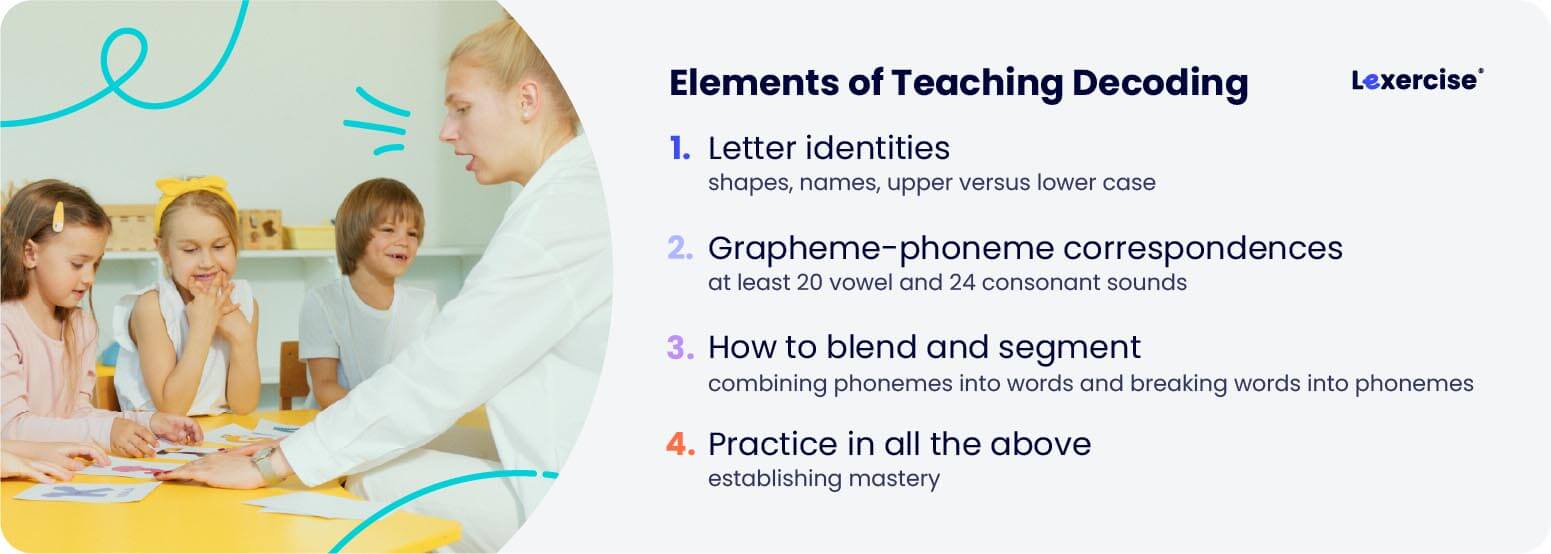
Addressing implementation science for orthographic mapping (decoding), Linnea Ehri (2020) lists four “necessary” things that teachers must implement:
- Explicit instruction of letter identities (shapes, names, upper versus lower case)
- Explicit instruction of grapheme-phoneme correspondences (for at least 20 vowel sounds and 24 consonant sounds)
- Explicit instruction in how to blend and segment (blending separate phonemes to form whole spoken words and segmenting whole spoken words into constituent phonemes)
- Adequate practice in all the above to establish mastery.
This looks like a pretty simple list. But there is a lot to unpack here! For effective implementation, teachers need more than the list of principles. They need to unpack the principles.
Unpacking the Science of Orthographic Mapping
Let’s unpack Ehri’s Science of Reading principles for teaching orthographic mapping.
| Science-Backed Principles | Notes for Unpacking |
|---|---|
| Use explicit instruction | NOTE 1: Explicit means clear, concise, consistent. Explicit concept teaching enables students to make sense of complexity. For example, a student who struggles with the word material may need a clear explanation of why the first vowel, spelled -a-, is not pronounced as it is in mat. NOTE 2: It is unnecessary to explicitly teach every student every pattern. According to the Science of Reading, the goal of explicit instruction is to provide sufficient explicit instruction so that the student’s implicit learning (sometimes referred to as self-teaching) can take over. |
| Teach letter identities | NOTE 1: The brain differentiates similar letters by integrating the letter’s name with the motor pathway used for forming the letter. This means that letter formation (writing) must be integrated into the reading curriculum. See: Why Letter Formation Matters…(article) |
| Teach grapheme-phoneme correspondences (for at least 20 vowel sounds and 24 consonant sounds) | NOTE 1: Ehri’s list specifies that vowels and consonants are explicitly taught primarily as speech sounds as opposed to letters. This enables the student to use their oral language to master reading and spelling. For example, a student who knows the spoken word, quit, will be able to segment its speech sounds (“k-w-ih-t”) and identify that the word has only one vowel sound, “ih” spelled -i-, with the letter -u- representing the consonant, “w”. This requires a curriculum that includes explicit instruction for all 20 vowel sounds and 24 consonant sounds. |
| Teach how to blend and segment the phonemes in words | NOTE 1: There is wide variability in how much instruction and practice students need to develop segmenting and blending (phonemic awareness) skills. Most struggling readers have at least initial difficulty segmentingspeech sounds in spoken words. For example, given the word fish, they may struggle to pronounce all three sounds: “f”-” ih”-” sh” and instead fuse two sounds together, like “f” – “ish”. However, studies show that given adequate explicit instruction and practice, segmenting is a very teachable skill. But adequacy is student-specific. NOTE 2: In a standard, unselected classroom, studies have shown that about 60% of students grasp blending relatively quickly with basic instruction, while 30% to 40% struggle with it. For example, a student may correctly pronounce the letter-sounds in bun (“b” – “uh” – “n”) but then say the word is bug orbat, often due to difficulty holding the sounds in memory long enough to fuse them. A recent Science of Reading consensus is that these phonemic awareness skills are more efficiently mastered when taught and practiced with letters rather than with colored blocks or other place holders. |
| Provide adequate practice | NOTE 1: Practice matters a lot because most learning is implicit and because implicit learning is much more efficient than explicit learning. While explicit instruction and error correction are essential for nearly all students, there is wide variability in how much practice students need to reach mastery. NOTE 2: Class time (or seat time) is a highly inaccurate proxy for practice. Practice needs to be measured in response opportunities. See: Making a Case for Practice (article) |
| Establish mastery | NOTE 1: This requires a system for tracking mastery that aligns with the curriculum. |
Might The Science of Reading Movement Do More Harm Than Good?
The recent push by schools to incorporate the Science of Reading is a well-intentioned effort to align teaching methods with the current scientific consensus about how humans learn to read. But, as noted above, schooling is complex. When a method is delivered without implementation fidelity, for example, lacking adequate explicit instruction and/or practice for a given student, improvement is unlikely.
Of course, lack of improvement is harmful enough, as the student falls further and further behind. But perhaps even more harmful, an inadequately implemented method can lead to the false impression that the student is incapable of improvement.
Reading Instruction Should Work Like a Fitness App
Reading instruction should have some features like a fitness app. It should include ongoing progress monitoring and mastery tracking. Then, parents and teachers could always log in and check on a student’s progress.
They could see which lessons had been taught, which concepts had been introduced, how much practice had been completed, which areas were causing problems, and see a snapshot of the student’s mastery of the key skills, such as decoding, spelling, and comprehension. A coach (parent or teacher) could use the data to motivate the student to practice, understand, and correct errors, and overcome roadblocks.

Lexercise: Implementing the Science of Reading With Fidelity
Lexercise actually works a lot like a coach with a fitness app!

If you are a parent of a struggling reader and would like to learn more about how we do the Science of Reading, read more here. If you want to talk to a qualified structured literacy specialist to learn about how Lexercise can help your child, you can reach out here. And if you would like to test your child for a reading, writing, or spelling problem, use our free dyslexia test.

If you are a teacher or school administrator and would like to learn more about how Lexercise can help you implement the Science of Reading in your class or school, you can read more and request a demo here.
Improve Your Child’s Reading
Learn more about Lexercise today.
Schedule a FREE
15-minute consultation